If you have bunions, you already know how this goes. You spot a gorgeous pair of shoes, feel that little spark of excitement, then reality kicks in — will these fit? Will I be limping by noon? Can I make it through a full workday without kicking them off under my desk?
I’ve been there. After years in the footwear industry — designing sandals, working with brands, and running FootWisdom— I can say with confidence: finding comfortable shoes for bunions that also look good is completely doable. It just takes knowing what to look for and which specific shoes actually deliver.
This guide covers both goals equally. Comfort, yes. But also a flattering, put-together look that doesn’t broadcast “I have a foot problem.” Because you deserve both.
Quick preview of what we’re shopping for: a wide toe box, soft uppers, a low heel (ideally under 1.5 inches), and a cushioned, supportive insole. I’ve organized picks into four categories — sneakers, dress shoes, sandals, and work shoes — and every recommendation has been personally tested or thoroughly vetted.
Table of Contents
What makes a shoe actually bunion-friendly
To understand why certain shoes work and others fail miserably, it helps to know what a bunion actually is. A bunion (hallux valgus) is a bony bump at the base of the big toe joint — it forms when the big toe gradually angles toward the second toe, causing the joint to protrude outward. That protrusion becomes a pressure point on the inner forefoot. Over time: redness, swelling, the kind of aching that makes every step feel like a small punishment.
The problem with most shoes is that they’re designed for a foot that tapers toward the toes. Almost no one’s foot actually does that. A narrow toe box squeezes the forefoot, compresses the bunion joint, and grinds against the bump directly. The result is inflammation, blisters, and worsening deformity over time.
The wide toe box: non-negotiable
If there’s one feature that separates a bunion-friendly shoe from everything else, it’s the wide toe box — the section where your toes actually sit. A wide toe box lets the toes spread naturally without pressing together or pushing against the sides of the shoe. For bunion sufferers, that space is the difference between agony and actual comfort.
Look for shoes described as “wide fit” or “wide toe box,” or those shaped with a rounded or squared toe box rather than a tapered point. Even a shoe that looks reasonably round from the outside can have a surprisingly narrow inner last, so always check the fit against the widest part of your foot.
Soft uppers: materials that flex instead of dig
The upper wraps around your foot, and the material matters enormously when you have a bunion. Stiff leather, synthetic panels, and rigid overlays all create pressure points directly on the bump. What you want are materials that flex and adapt.
Soft full-grain leather is excellent — it stretches and molds to your foot over time. Engineered mesh and stretch knit are even more forgiving and can handle swelling throughout the day. Stretch fabric uppers in particular adapt to your foot’s specific shape rather than forcing your foot into a predetermined mold.
Avoid anything with hard stitching, rigid overlays, or seams that run across the bunion area. Even a small interior seam sitting directly on the joint can become unbearable by hour three.
Cushioned insoles and arch support
A bunion doesn’t just affect the front of your foot — the altered gait that comes with bunion pain can create secondary stress in the arch, heel, and even the knee. A well-cushioned insole with solid arch support helps distribute your weight more evenly across the foot, taking some load off that already-stressed big toe joint.
Bonus if the insole is removable. That means you can swap in custom orthotics, which can be genuinely transformative for people with moderate-to-severe bunion pain. If you’re curious about the different types available, our guide to 8 common types of insoles is a good place to start.
Heel height: keep it low
Heel height is one of the most underrated factors in bunion comfort. The moment you raise the heel, your body weight shifts forward onto the forefoot — directly onto the bunion. Even a modest two-inch heel can dramatically increase pressure on the big toe joint.
The sweet spot is under 1.5 inches. A slight elevation (around 0.5 to 1 inch) can actually help some people because it reduces tension on the plantar fascia, but anything higher starts working against you. If you need a heel for dress occasions, block heels and kitten heels distribute weight better than stilettos or wedges.
Seamless interiors
Interior seams, overlays, and decorative stitching against the skin create friction and hotspots — and when that friction sits right over a bunion, it becomes blistering and pain quickly. Look for smooth, seamless linings and padded collars, with no rough edges near the toe box.
Best sneakers for bunions (picks 1–3)
Sneakers are usually the first place people look when bunion pain starts, and for good reason. Athletic footwear brands have invested heavily in cushioning technology, wide-fit options, and flexible uppers — which are exactly what bunion sufferers need. The right sneakers feel like genuine relief the moment you put them on, and the best silhouettes are clean and modern enough that they don’t look remotely clinical.
Pick 1: Hoka Bondi (Wide)
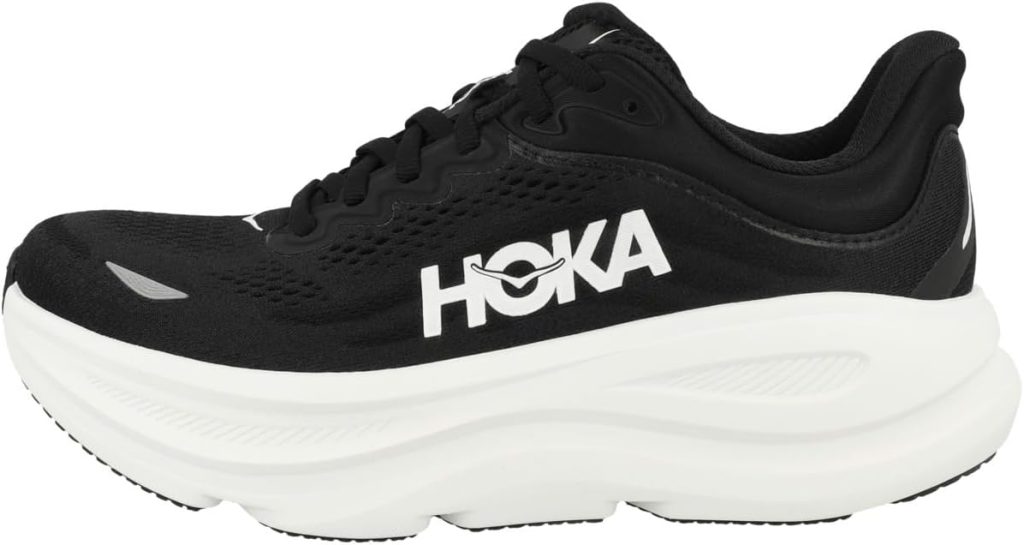
The Hoka Bondi comes up consistently in conversations with podiatrists and orthopedic specialists, and it’s one of my top picks, too. The wide-fit version has a genuinely roomy toe box — not just “roomy for a running shoe” roomy, but actually accommodating for a foot with a bunion bump.
The engineered mesh upper is soft and breathable, with minimal overlays over the forefoot. No hard edges pressing against the bunion joint. The real standout is the thick EVA midsole: it delivers maximum cushioning, absorbs shock beautifully, and takes a lot of impact load off your forefoot with every step.
Visually, the Bondi’s thick, rounded silhouette actually works in your favor. The shoe is substantial enough that the slight asymmetry of a bunion gets absorbed into the overall profile. The shoe becomes the focal point, not your foot.
Price range: $165–$185 | Where to buy: Check price on Amazon
Pick 2: New Balance Fresh Foam X 1080 Wide
For people whose bunions swell throughout the day — hello, 4 pm foot — the Fresh Foam X 1080 in wide width is something of a revelation. The stretch-engineered mesh upper expands with your foot rather than fighting it, so the shoe that felt comfortable in the morning still feels comfortable after hours of wear.
The Fresh Foam X midsole is plush without being unstable, the wide fit provides genuine forefoot room that standard widths simply can’t offer, and the rounded toe box means nothing is pushing laterally against the bunion joint.
The 1080 comes in clean, minimal colorways that look put-together for casual wear — pairs easily with jeans or athleisure without looking like a medical device.
Price range: $165 | Where to buy: Check price on Amazon
Pick 3: Altra Torin
Altra builds the Torin on what they call a “FootShape” toe box — genuinely wide and foot-shaped from the start, not tapered. For bunion sufferers, that distinction matters. The toe box mirrors the natural spread of the toes, leaving the bunion area completely uncompressed.
The Torin also runs on a zero-drop platform (with heel and forefoot at the same height), which encourages a more natural gait and keeps weight evenly distributed rather than shifted forward. The removable insole is a practical bonus — pull it out and replace it with a custom orthotic for even better support.
From the outside, the Torin reads as a clean, modern lifestyle sneaker. The wide toe box doesn’t look strange; it just looks like a well-proportioned shoe. Nobody glancing at your feet is going to think “bunion shoe.”
Price range: $140–$150 | Where to buy: Check price on Amazon
Best dress shoes for bunions (picks 4–6)
Yes, you can wear stylish dress shoes with bunions. The idea that comfortable shoes for bunions have to look orthopedic or frumpy is outdated. The key is being strategic about construction, material, and silhouette — and the three picks below prove that elegance and bunion-friendliness aren’t mutually exclusive.
Pick 4: Vionic Adalena (block-heel pump or low kitten heel)
Vionic has quietly become one of the most bunion-friendly dress shoe brands on the market, largely because they build podiatrist-designed arch support into shoes that actually look like fashion footwear. The Adalena, with its low block heel and rounded toe, is a standout example.
The heel sits at just under 1.5 inches — right at the top of the bunion-safe zone — and the block shape distributes weight broadly rather than concentrating it at a single point. The rounded toe provides enough forefoot room for a mild-to-moderate bunion without looking boxy or unflattering.
The leather or faux-leather upper is soft enough to flex over the bunion area, and Vionic’s orthotic footbed provides arch support you actually feel with every step.
Styling note: block-heel pumps in dark neutrals — black, deep burgundy, navy — draw the eye to the heel and the overall silhouette, not the toe area. This is one of the most effective ways to wear a closed-toe dress shoe while keeping the bunion area as inconspicuous as possible.
Price range: $130–$160 | Where to buy: Check price on Amazon
Pick 5: Orthofeet Celina (ballet flat)
Ballet flats are a minefield for bunion sufferers — most are cut too narrow and too shallow, pressing directly on the joint. The Orthofeet Celina is the exception. It’s built on an extra-wide last with a seamless, stretch-fabric upper that accommodates the bunion bump without pressure points.
The interior is completely smooth — no stitching ridges, no hard overlays — which means no hotspots even after hours of wear. The cushioned insole with anatomical arch support blows past the paper-thin insoles most ballet flats come with.
From the outside, it reads as a classic, elegant flat. The stretch fabric sits smoothly against the foot rather than straining visibly around the bunion area, which is exactly what you want for a polished appearance.
Price range: $125–$145 | Where to buy: Check price on Amazon
Pick 6: Orthofeet Quincy (wide loafer)
A well-made loafer is one of the most versatile items in a wardrobe, and the Orthofeet Quincy delivers the professional look of a classic loafer with construction that actually accommodates bunions. The wide forefoot, padded collar, and cushioned insole work together to make this shoe forgiving over long periods.
The upper is soft leather or suede — materials that mold to your foot’s specific shape over time, including the bunion bump. No rigid overlays over the joint, just smooth, flexible material.
One tip for any dress shoe that fits well but still leaves your bunion feeling slightly exposed: a silicone bunion pad (sometimes called a gel bunion shield) placed inside the shoe over the joint adds a layer of cushioning that makes a noticeable difference in comfort. Small investment, worthwhile return.
Price range: $140–$160 | Where to buy: Check price on Amazon
Best sandals for bunions (picks 7–9)
Here’s the thing about sandals and bunions: they can be the most liberating option or the most painful one, depending entirely on strap placement. Open-toe designs completely remove the pressure of a closed-toe box, which is wonderful. But a strap that runs directly over the bunion joint creates its own form of torture.
The rule is simple: straps should fall above or below the bunion joint, never directly over it. When this works out, a well-fitting sandal can make bunions far less noticeable than an ill-fitting closed shoe that strains visibly around the bump.
Pick 7: Birkenstock Arizona

The Birkenstock Arizona is probably the most bunion-friendly sandal ever designed, and that’s not an accident — it’s the result of a footbed refined over decades. The contoured cork-and-latex footbed cradles the arch, cups the heel, and positions the foot in genuine anatomical alignment.
The two wide, adjustable straps cross the foot at the instep and above the toes — both spots that naturally avoid the bunion joint. The buckle closures let you dial in the fit precisely, which matters when one foot (usually the one with the worse bunion) is larger or wider than the other.
The deep toe box impression in the footbed lets toes spread freely, and because the foot isn’t enclosed, nothing presses against the bunion during wear.
I’ve written a full guide to Birkenstocks and foot health at FootWisdom.com because they come up constantly in conversations about bunions, plantar fasciitis, and general comfort.
Price range: $110–$145 | Where to buy: Check price on Amazon
Pick 8: Vionic Cruz (sport walking sandal)
For more active wear — travel, errands, long walking days — the Vionic Cruz is a solid pick. The multiple adjustable straps are engineered to cross the foot in positions that frame the forefoot rather than cutting across the bunion area.
Vionic’s orthotic footbed is built directly into the sandal, providing arch support most casual sandals don’t bother with. This matters because poor arch support leads to overpronation, which increases the inward angling force on the big toe — exactly what makes bunions worse over time.
The sporty look is clean and contemporary, and the wide strap placement creates a visual frame around the foot that draws less attention to the inner edge (where the bunion sits) than a narrow, delicate strap would.
Price range: $100–$120 | Where to buy: Check price on Amazon
Pick 9: Soft-elastic dressy strappy sandal (look for stretch bands)
For evenings out or more polished occasions, look for dressy sandals built with soft elastic or stretch-band straps rather than rigid leather. Naturalizer and Clarks both have options here that prioritize forgiving materials while maintaining an elegant look.
The stretch bands adapt to your foot’s exact shape — including any irregularity from the bunion bump — without creating visible strain lines or digging into the joint. Before buying, verify that no fixed strap sits directly over the first metatarsophalangeal joint. Ask yourself: Does this strap cross the widest, most protruding part of my foot? If yes, keep looking.
A thin metallic or neutral-toned stretch-band sandal can look exceptionally put-together, and because the bands flex around the foot rather than highlighting its shape, a well-fitted pair can actually make your feet look more elegant than a stiff, ill-fitting closed shoe.
Price range: $80–$130 | Where to buy: Check price on Amazon
Best work shoes for bunions (picks 10–11)
Professional footwear is where bunion management gets genuinely hard. Workplace dress codes often demand closed-toe shoes, polished materials, and a level of formality that seems incompatible with bunion comfort. The footwear market has come a long way on this, though, and there are now strong options that meet workplace standards without sacrificing your feet.
Pick 10: Orthofeet Gramercy (wide Oxford)
For office environments, client-facing roles, or any situation that calls for a traditional lace-up shoe, the Orthofeet Gramercy in wide width is a standout. The leather upper is soft and flexible, the wide-fit last provides genuine forefoot room, and the cushioned midsole delivers serious support for long hours on hard floors.
Lace-up closures are especially useful for bunion wearers because they let you adjust tension across different parts of the shoe. Loosen the forefoot section while keeping the midfoot snug — a small adjustment that makes a real difference on a bad bunion day.
The Gramercy looks like a classic, polished Oxford. Dark leather in black or deep brown creates a professional silhouette, drawing the eye to the shoe’s clean lines rather than the shape of the foot inside it.
Sizing note: Orthofeet tends to run true to size in length, but their wide-fit versions are genuinely wide. If you’re between widths, go wide.
Price range: $149–$169 | Where to buy: Check price on Amazon
Pick 11: Dansko Professional (supportive clog)
If you work in healthcare, retail, food service, or anywhere you’re on your feet for eight-plus hours, the Dansko Professional is a legitimate institution — and for good reason. The roomy toe box accommodates the forefoot without compression, the high-quality leather softens with wear, and the slip-resistant outsole is essential for fast-paced environments.
The padded instep collar prevents rubbing at the top of the foot, and the built-in arch support reduces fatigue from standing on hard floors all day. The rocker-bottom sole promotes a natural rolling gait that takes pressure off the forefoot — a direct benefit when your bunion is already doing the heavy work.
For maximum bunion relief during all-day shifts, pair the Dansko Professional with a silicone bunion cushion over the joint and thin compression socks underneath. The combination significantly reduces both friction and inflammation, especially toward the end of a long day.
Sizing note: Dansko clogs fit more like a range than a precise size. When in doubt, size up by half a size to make sure the toe box has room for a bunion.
Price range: $140–$165 | Where to buy: Check price on Amazon
How to shop for bunion shoes like a pro
Even the best shoes will fail you if you buy the wrong size or shop at the wrong time. A few habits that actually make a difference:
Shop in the afternoon or evening. Feet swell throughout the day — sometimes by as much as half a size. A shoe that fits perfectly at 9 am might feel uncomfortably tight by 3 pm. Shopping later means you’re fitting your foot at its largest, which is what actually matters.
Trace both feet. Stand on a piece of paper and trace each foot with a pen held vertically. You’ll almost certainly find one foot is slightly larger than the other — and with bunions, the wider foot is usually the one with the more developed bump. Always fit to the larger, wider foot.
Use the thumb-width test. Press your thumb against the shoe tip above your longest toe. There should be roughly a thumb’s width of space between the toe and the end of the shoe. Too little and the toes compress; too much and the foot slides forward, creating friction on the bunion area.
Wear the right socks. Always try shoes on with the socks, tights, or hosiery you plan to wear with them. A thick cushioned sock can completely change the fit equation.
Walk on a hard surface. Most shoe stores have carpeted fitting areas, but carpet hides a lot. Find a tile or hardwood surface to walk on — that’s where you’ll notice any sliding, rubbing, or pressure the carpet was masking.
Know your options after purchase. If a shoe fits well everywhere except it’s slightly snug over the bunion bump, don’t give up on it. Stretching sprays can soften and slightly expand leather and faux-leather uppers. A cobbler can stretch specific areas of the shoe — including the bunion zone — for around $10–$20. It can save an otherwise excellent pair.
Conclusion
Bunions don’t have to mean a lifetime in ugly shoes, or a daily choice between looking presentable and surviving until dinner without pain. The picks in this guide — across sneakers, dress shoes, sandals, and work shoes — prove that wide toe boxes and soft uppers can coexist with real style.
What ties every recommendation together: space for the bunion to exist without compression, materials that flex instead of press, and support structures that keep the rest of the foot comfortable enough to compensate for what the bunion is dealing with.
My advice is always to prioritize fit over aesthetics — but the honest truth is that the best bunion-friendly shoes today are designed well enough that you mostly don’t have to choose. The Hoka Bondi delivers serious cushioning and a clean, athletic silhouette. The Birkenstock Arizona offers decades of foot-health refinement and iconic style. Vionic gives you podiatrist-approved construction in shoes that look like fashion footwear. That’s not a compromise — that’s the category actually improving.
For more, check out the other footwear and foot health guides — including deep dives into orthotics, hallux rigidus, plantar fasciitis, and seasonal shoe guides built around real foot health principles.
And for what it’s worth: choosing shoes that work for your feet isn’t vanity, and it isn’t settling. You’re on your feet for thousands of hours a year. Might as well be comfortable.
Author